
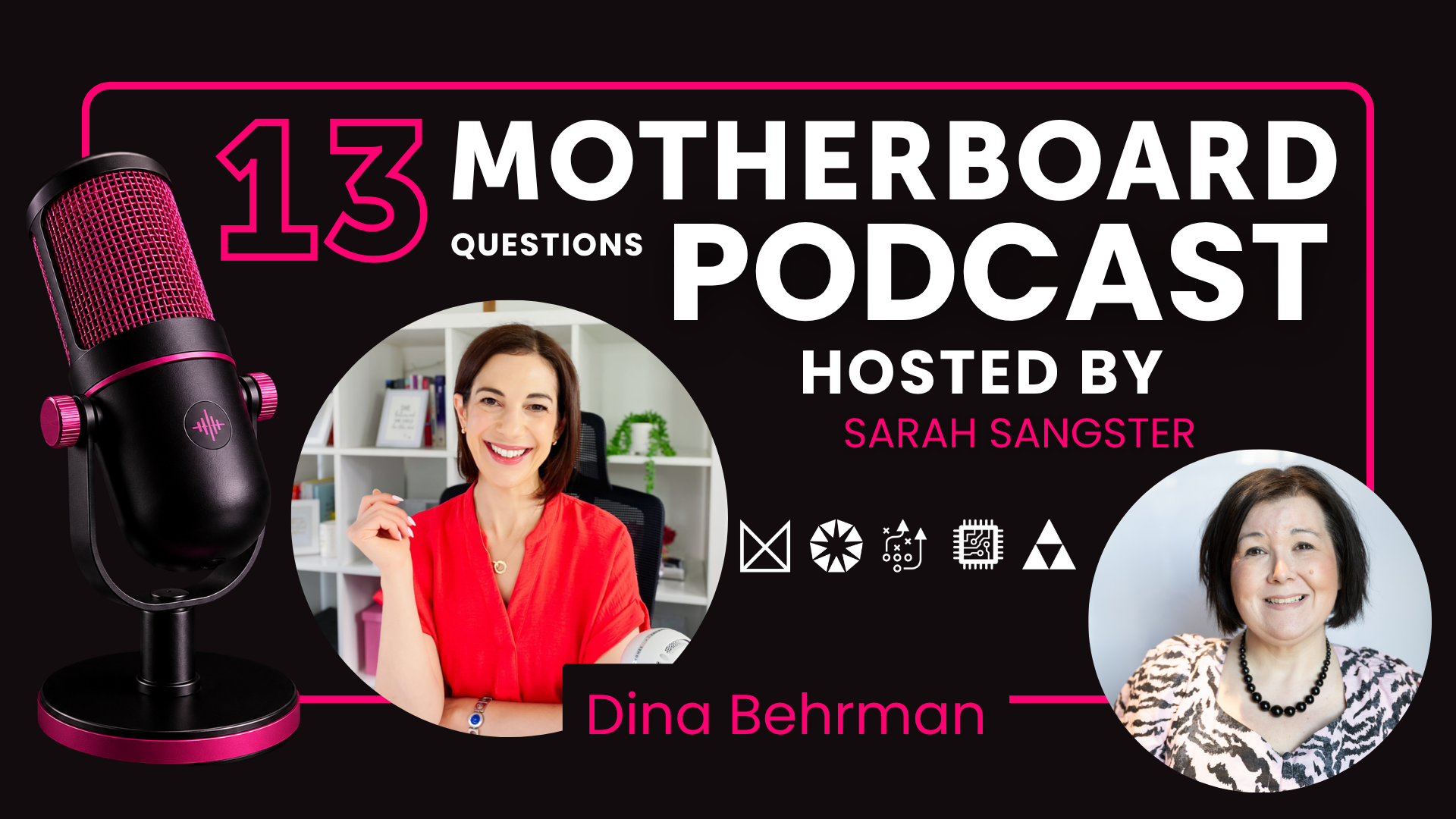
Episode 1: Dina Behrman
Welcome to the Motherboard podcast. I'm sitting down with PR strategist and former journalist Dina Behrman today to explore the 13 key areas of business through the Motherboard Questions. The Motherboard framework is built around 13 areas that every business owner should be working on to build a business they not only love, but one that supports their life rather than consumes it.
Through Dina's answers, the episode explores visibility, trust, confidence, delegation, alignment, marketing, client relationships, bank balance, and what success looks like behind the scenes of running a business. Drawing from her background in journalism and over a decade in pr, Dina shares honest insights into building authority, creating genuine human connection, and growing a business in ways that feels aligned rather than forced.
This episode is full of grounded reminders that sustainable growth is built through trust, consistency, credibility, and staying connected to who you are while growing your business.
Enjoy.
Connect with Dina on LinkedIn - https://www.linkedin.com/in/dinabehrman/
Connect with Sarah on LinkedIn - https://www.linkedin.com/in/sarah-sangster/
Would you like to answer your own 13 questions?
Drop Sarah an email here - sarah@sanx.co.uk
FULL TRANSCRIPT
Sarah Sangster [00:00:00]:
Welcome to the Motherboard podcast. I'm sitting down with PR strategist and former journalist Dina Behrman today to explore the 13 key areas of business through the Motherboard Questions. The Motherboard framework is built around 13 areas that every business owner should be working on to build a business they not only love, but one that supports their life rather than consumes it. Through Dina's answers, the episode explores visibility, trust, confidence, delegation, alignment, marketing, client relationships, bank balance, and what success looks like behind the scenes of running a business. Drawing from her background in journalism and over a decade in pr, Dina shares honest insights into building authority, creating genuine human connection, and growing a business in ways that feels aligned rather than forced. This episode is full of grounded reminders that sustainable growth is built through trust, consistency, credibility, and staying connected to who you are while growing your business. Enjoy. Tell me a little bit about you, what you do, who you do it for, and the results that you get for people.
Dina Behrman [00:01:04]:
I'm a former journalist turned PR strategist, run a BT PR agency and consultancy and I work with entrepreneurs and founders, so coaches, consultants and service based business owners typically, and I help them to share their stories and their expertise in the press, so in publications, podcasts, tv, radio, blogs. And I help them to then use that publicity to position themselves as an authority in their field, to reach more of their ideal clients and to create a bigger impact and ultimately grow their business as well.
Sarah Sangster [00:01:43]:
And how long have you been doing that for?
Dina Behrman [00:01:45]:
For over 10 years now.
Sarah Sangster [00:01:47]:
And you love what you do?
Dina Behrman [00:01:49]:
You. Yeah, I do, I do. I think when I was younger I always wanted to be a journalist and I always loved storytelling and stories and books. And then I worked as a journalist for about 10 years, which I loved. But then I, I moved into having my business and that became my main focus. And so it's, it's always been along kind of similar lines.
Sarah Sangster [00:02:16]:
Amazing. So part of the motherboard, there's 13 areas. So the questions I'll ask will be the same for everybody and I just want your take on it. So we're going to start with you. What part of who you are has helped you most in business?
Dina Behrman [00:02:29]:
I would say, I think funnily enough, because I'm more of an introvert, I think that has helped me in terms of being able to work with clients, to help them to get visible in a way that feels good to them without feeling like they have to be the loudest person in the room, you know, without feeling like, well, what do I do if I'm not a natural in the spotlight? Or if I'm not an extrovert. And I think that has really helped me because there are a lot of blocks that come up for people when it comes to visibility, whatever level they're at. And so I think having that understanding myself and having been through that myself and having had times when I've not felt comfortable being visible and being able to overcome that myself and put myself out there, and now I've helped hundreds of clients over the years to be able to do that. I think that's something that gives me a bit of a different outlook on it, which can be really helpful.
Sarah Sangster [00:03:24]:
Yeah, that's so amazing. What is the one thing that you do that helps you protect your time and energy whilst growing your business?
Dina Behrman [00:03:32]:
Delegating, which it took me a while to get to the point where I felt comfortable handing things over to other people because definitely earlier on in my business I just wanted to do it all myself. And actually delegating things out to people who can do these things more quickly and often more efficiently than I would be able to gives you back so much time. So I have a virtual assistant that helps me with like the admin side of things. And she's also a web designer, so she can do all of the background back end stuff on my website when I need it. And then I have freelance PRs who I work with that help me with delivering PR services for my clients as well. And that frees up so much of my time to be able to delegate those tasks to them.
Sarah Sangster [00:04:18]:
Yeah. So, so important, isn't it, the numbers? What is the biggest lesson that you've, you've learned about money or pricing? As a business owner, I think one
Dina Behrman [00:04:27]:
of the things that I've learned, and it's not strictly across the board but just in, in general, in my experience, the people who invest at a very low price point typically aren't as invested in as the people that invest at a higher price point. And especially when I'm doing, for example, the consultancy work or I've got a group program that I run, I find that when people have invested just a slightly higher price point, they've got more skin in the game, they're more emotionally invested and they are much more likely to take action.
Sarah Sangster [00:05:10]:
Yeah, amazing. What business decision have you made has made the biggest positive difference on your
Dina Behrman [00:05:16]:
lifestyle or freedom, just deciding to launch the business in the first place? Because prior to that, like I said, I was working as a journalist and I was reflecting on this the other day, I had so many amazing experiences working as a journalist. But it just wasn't conducive to. It was something I did when I was young. I was single, I didn't have kids, and I was working in house on different magazines and I'd be traveling into London every day and I'd be going out to parties and I used to report from, like, red carpet events. And I got to have all these incredible experiences, but it's not conducive to the lifestyle that I have now and being a mum, et cetera. So launching my business meant that I could be my own boss, have my own hours, work the business in the way that works for me.
Sarah Sangster [00:06:00]:
Amazing. What type of content or marketing has genuinely worked best for your business?
Dina Behrman [00:06:06]:
It's funny because I think it changes over the years and I've seen so many different trends come and go and there are things that might have worked at one point and then they stop working. And so for me, the thing that has really endured has been PR for my own business, which is something that I go through phases of focusing on it for myself because I get caught up in the business and then I'm like, I need to do more of that for myself. But it always pays off. And I have clients that have found me from articles that came out maybe two or three years ago, and they're still able to find me via them. And I think that there are other marketing methods, whether it's networking or collaborations or, you know, doing something like this, jumping on a podcast like this. They all come down to the same principles of the way that I see pr, which is leveraging other people's audiences and creating those collaboration opportunities. And I think anything that involves connecting with people and getting in front of other people's audiences really, really pays off.
Sarah Sangster [00:07:13]:
Yeah, absolutely. What qualities make someone your ideal customer or prospective client?
Dina Behrman [00:07:19]:
For me, it's established business owners. So people that aren't brand new in business, they know who their ideal client is, they know what they're selling, what their offer is, they know what their area of expertise is, because then I can really help them to get into the media outlets that will get them in front of their ideal clients. I can help them to share and showcase their expertise. And so people who are established in business and have an understanding or at least an interest in the idea of pr, of putting themselves out there.
Sarah Sangster [00:07:53]:
Yeah, great. What do you think makes people truly pay attention to your brand today?
Dina Behrman [00:08:00]:
I think it's the trust element, because everyone's talking about the fact we're in a trust recession at the moment, and so people now more than ever need to feel like they can trust a business before they, you know, invest money in it. So I think that I, I'm really focused on helping my clients to create that trust for their potential clients. And it's something that I focus on myself. And so doing things like PR helps people to get to know like, and trust you, and it helps with your positioning and it helps with your, you know, authority status. And so I think that having a brand that people can trust makes you stand out because there's so much noise in the online space at the moment and there's so much AI generated content that it makes people feel less trusting. And so having something that really instills trust in potential clients, you know, when they're seeing you again doing something like this, being interviewed on a podcast, and they can see the real you and not just AI generated copy, which is everywhere and which often sounds exactly the same as what everyone else is putting out there. And it's something that is, you know, it's quality over quantity that's important because AI can generate the quantity.
Sarah Sangster [00:09:37]:
Yeah.
Dina Behrman [00:09:37]:
But it doesn't have the quality and the things that will actually make people feel like they can trust you. So anything that you can do that really helps people to feel like they can trust you is really important for anyone's personal brand.
Sarah Sangster [00:09:52]:
Yeah, absolutely. And the next question does contain trust. So the nurture process, how have you built trust and long term relationships within your business? So once you've got that trust, how do you build on that?
Dina Behrman [00:10:05]:
So definitely things like using PR to create deeper emotional connections with potential clients. Science. Because I think a lot of content, especially when it is AI generated, it can feel quite surface level. And so if you do a full length article, I had a piece out in a magazine last week and it was a full length article and it was, you know, different questions about, you know, why I started the business and what my motivation is and what my, you know, ethos is when it comes to business and all of those things. So people really get to know me on a deeper level. So, so things like that help nurture people and help them to get to feel like they know like, and trust you, which is really important. And then I think it's, it's bringing in those aspects from, you know, having people refer you and doing collaborations and all of those things where I think they just all kind of work together in terms of creating opportunities for people to get to experience the real you.
Sarah Sangster [00:11:12]:
Yeah, lovely. So opportunity, how do you personally spot opportunities in business and what have you learned about knowing when to say yes and when to say no.
Dina Behrman [00:11:22]:
I think having opportunities that feel aligned is the most important thing because there are so many opportunities out there. And I know that when I'm working with clients and we're looking at, for example, different PR opportunities, it's got to be the opportunities that feel aligned. So there's certain things that will take you out of your comfort zone and I think that's good. I think it's good to stretch your comfort zone. So the past couple of years I've been doing a lot more like public speaking, and that's definitely stretched my comfort zone. But it feels good, it feels aligned. I'm excited to do it. And so I think something that feels a little bit uncomfortable is good, but when it's feeling totally not aligned, then it's no good.
Dina Behrman [00:12:09]:
And I've had experiences in the past. I joined a very high ticket marketing mastermind a few years ago and followed the coaches formulas for marketing and it did not feel aligned. And, and it didn't work for me because the energy behind it was wrong. So I was posting, posting, posting, following this person's, you know, blueprint formula, et cetera, and the energy behind it was so off. People were picking up on that. And that type of thing will repulse your ideal client rather than attracting your ideal client. And when I went back to doing the stuff that felt aligned and focusing on being interviewed on podcasts, writing guest articles, speaking on stages, collaborating with people, networking, all of those things, then those led to me having clients approaching me and attracting clients to me. So finding the opportunities that feel aligned and you will know if it feels good.
Sarah Sangster [00:13:18]:
Yeah, that's brilliant. What do you think people come to you for that goes beyond your actual product or service?
Dina Behrman [00:13:24]:
I think because I have a background working as a journalist that gives me a bit of an edge when it comes to PR, because I spent 10 years working as a journalist being on the other side of the fence. And so I know how the media works. And I've got that experience of being the person that's, you know, receiving pictures. I had a couple of years when I was working as the commissioning editor at a newspaper supplement and I would be the one receiving all the press releases and all the pitches from people wanting to get featured. And so I think because I've had that insight, I can really help business owners know what journalists are looking for. And I think that, you know, people don't always get it right and they don't always understand what journalists are looking for. And sometimes they Think that it's enough to just say, this is my business, this is what I'm doing, write about my business. And that's not enough.
Dina Behrman [00:14:19]:
There has to be more there. That's why, you know, I talked about why I help my clients to share their stories and to share their expertise, because those are the things that journalists are interested in. And so I think having that background and having had that insight myself is really helpful. And clients know that I can help them to really understand how the media works.
Sarah Sangster [00:14:42]:
Yeah, it's amazing. What has helped you become more confident when it comes to selling your work or expertise?
Dina Behrman [00:14:48]:
I think just sometimes it's about just taking the action, and that actually builds the confidence, because I think sometimes we want to feel like we are going, you know, we want to wait until we feel confident enough to do certain things. Sometimes doing the thing is what builds the confidence. So just being out there and. And selling and connecting with people I think helps to build confidence.
Sarah Sangster [00:15:18]:
Amazing. What's something that you are proud of when it comes to the experience your clients or customers receive?
Dina Behrman [00:15:24]:
I think the fact that I like to give my clients, you know, personalized support and to give them the personal touch when they're working with me. So when I work with clients who have hired us to do PR for them, we only work with a small number of clients at any one time. So they're never going to feel like they're, you know, one of many that aren't getting attention. They each get that personalized attention. And then when I'm doing my group program, I want to be able to give clients the support that they need. So, you know, I'll give them feedback on their pitches and their press releases. I've got a journalist coming to speak to the people in my group program this week and to do a session with them on how best to picture them. And, you know, I'm happy to make those introductions and to really.
Dina Behrman [00:16:19]:
Yeah. Have that kind of personal touch when it comes to working with clients.
Sarah Sangster [00:16:24]:
Yeah. Amazing. And then when we look at Scout, what does success look like for you now in this stage of business?
Dina Behrman [00:16:31]:
End in life, I think success in general for me is being able to have that balance as much as it's possible, because I think it is always a bit of a juggle, but to have that balance where I'm doing work that I enjoy, but also I get to spend time with my kids, and also I have time to focus on myself. I know that in the past, I had times where I'd say, I don't have time to go to the gym. I don't have time to exercise, you know, and I would feel like I had to be sitting at my desk the whole time. And now I make sure every day that I either go to the gym or go for a walk or just something where I'm taking time for myself and I'm looking after myself and I'm keeping myself healthy. And then, you know, I do the school run each day and being able to pick my daughter up and and spend time with my kids if I had a huge amount of success in my business but I wasn't able to have that time with my family, that wouldn't feel like success. So it is as much as possible, I think having that balance, that's amazing.
Sarah Sangster [00:17:34]:
And then what's one question you'd like to ask the next person on the podcast?
Dina Behrman [00:17:40]:
The question would be what is your favourite life lesson quote? Like your favourite inspirational quote?
Sarah Sangster [00:17:47]:
Amazing.
Dina Behrman [00:17:48]:
Perfect.
Sarah Sangster [00:17:49]:
Well, thank you so much for joining today and we will look forward to hearing all of the things that are going on in your world as we connect with you with a greater audience of people going forward.
Dina Behrman [00:18:01]:
Thank you so much for having me.
Sarah Sangster [00:18:03]:
Wow. What a great episode and insights into the 13 key areas of business through the lens of PR strategist former journalist Dina Behrman. Through her answers to the motherboard questions, Dina shared a real, honest perspective on visibility, trust, confidence, alignment and building a business that supports life rather than consumes it. A major theme throughout the episode was authenticity. Dina spoke openly about being an introvert and how that actually became one of her strengths in business. Rather than believing success came from being the loudest person in the room, her answers consistently pointed back to showing up in ways that felt genuine and aligned. Trust was another huge takeaway. Across the episode, Dina reflected on the amount of noise online and how audiences become increasingly disconnected from surface level marketing and AI generated content.
Sarah Sangster [00:18:57]:
Her answers repeatedly highlight the importance of real storytelling, PR collaborations, cast referrals and meaningful human connections in in building credibility and long term relationships. There was also a strong thread around alignment and intuition in business. Dina shared experiences of following marketing formulas that looked successful externally but felt completely wrong internally, and how returning to strategies that felt natural to her created far better results and opportunities. Across the questions around time, confidence, delivery and scale, Dina's answers also revealed how important balance had become in this stage of her business and life. Learning to delegate, protecting energy and prioritising health and creating space for family had all become part of what success looks like for her now. Her journalism background added another layer of insights throughout the episode. Having worked on the media side herself, she understood what actually captures attention and why stories, expertise and emotional connection mattered far more than simply promoting a business. The biggest pattern throughout the 13 answers was clear.
Sarah Sangster [00:20:09]:
People connect with people. Not polished perfection, not volume, not forced visibility, but trust, consistency, credibility, and genuine human connection. See you on the next episode.